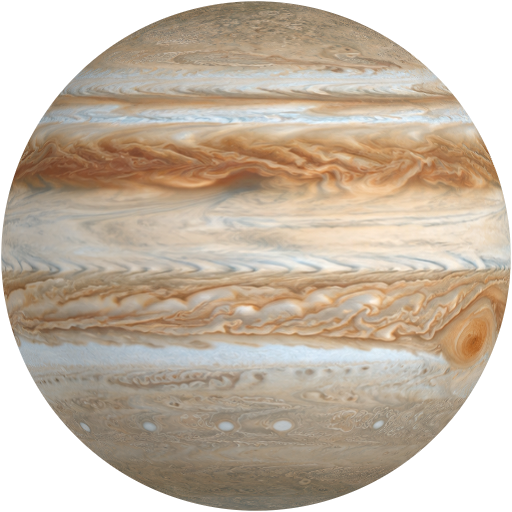
Fifth planetGas giant
The giant of the Solar System - more massive than all the other planets combined. Its Great Red Spot is a storm wider than Earth.
Key facts
Mass
318
× Earth
Radius
69,911 km
11.2× Earth
Gravity
24.79 m/s²
2.5× Earth
Temp
-110°C
cloud tops
Orbit & rotation
778.5 M km
from the Sun
5.2 AU
11.86 yrs
orbital period
orbital year
9.9 hours
length of day
fastest spin
Sunlight reaches here in 43 min
travelling at 299,792 km/s
Compared to Earth
Radius
11.0× Earth
Shown at reduced scale - true radius is 11.0× Earth.
Surface gravity24.79 m/s²
Blue line = Earth · scale 0–25 m/s²
A 70 kg person weighs177 kghere
Temperature
-110°Cmean surface
Pluto −230°Earth +15°Venus +465°
Atmosphere
Hydrogen90%
Helium10%
Moons & rings
115 known moons
Io ›Europa ›Ganymede ›Callisto ›
Rings Faint, dusty rings discovered in 1979.
Notable
- The Great Red Spot has been observed since the 1830s and may be older.
- Ganymede is the largest moon in the Solar System - bigger than Mercury.
- It has the shortest day of any planet despite being the largest.
1610
Discovery
Moons discovered by Galileo Galilei
Missions & exploration
1973
Pioneer 10FlybyNASA
First craft through the asteroid belt and past Jupiter.
1979
Voyager 1 & 2FlybyNASA
Discovered the rings and Io’s erupting volcanoes.
1995
GalileoOrbiterNASA
First to orbit; dropped a probe into the atmosphere.
2016
JunoOrbiterNASA
Peering beneath the clouds from a daring polar orbit - still active.
2030
Europa ClipperEn routeNASA
Launched in 2024 and scheduled to reach Jupiter in April 2030 to survey Europa’s hidden ocean.
2031
JUICEEn routeESA
Launched in 2023, scheduled to arrive at Jupiter in July 2031, and later orbit Ganymede.
Inside Jupiter
Molecular hydrogen78–100% of radius
Gas gradually turning liquid with depth
Metallic hydrogen20–78% of radius
An electric ocean powering a vast magnetic field
Diffuse core0–20% of radius
Likely “fuzzy” - rock dissolved into hydrogen
Getting there from Earth
At light speed
588 million km
33 min
Fastest real trip
Juno
5 years
By airliner
900 km/h, non-stop
75 years
By car
100 km/h, no breaks
671 years
Distances at closest approach; real routes are longer.