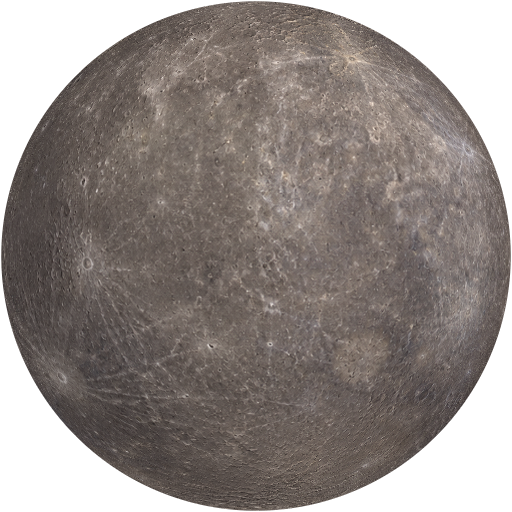
Innermost planetRocky world
A scorched, cratered world barely larger than the Moon. With almost no atmosphere to trap heat, it swings between blistering days and frozen nights.
Key facts
Mass
0.055
× Earth
Radius
2,440 km
0.38× Earth
Gravity
3.7 m/s²
38% Earth
Temp
-173→427°C
biggest swing
Orbit & rotation
57.9 M km
from the Sun
0.39 AU
88 days
orbital period
shortest year
58.6 days
length of day
rotation; solar day 176 days
Sunlight reaches here in 3.2 min
travelling at 299,792 km/s
Compared to Earth
Radius
0.383× Earth
Smaller than Earth.
Surface gravity3.70 m/s²
Blue line = Earth · scale 0–25 m/s²
A 70 kg person weighs26 kghere
Temperature
+167°Cmean surface
Pluto −230°Earth +15°Venus +465°
Atmosphere
Effectively none - only a wispy exosphere of oxygen, sodium, hydrogen, helium and potassium blasted off the surface by the solar wind.
Moons & rings
0 moons
Rings None.
Notable
- A single day (sunrise to sunrise) lasts longer than its entire year.
- Despite being closest to the Sun, it is not the hottest planet - Venus is.
- Its iron core makes up about 60% of its mass.
-
Discovery
Known since antiquity
Missions & exploration
1974
Mariner 10FlybyNASA
First close look - mapped 45% of the surface in three flybys.
2011
MESSENGEROrbiterNASA
First to orbit Mercury; found water ice in permanently shadowed craters.
2026
BepiColomboEn routeESA/JAXA
Twin orbiters are planned to enter Mercury orbit in November 2026 after six Mercury flybys.
Inside Mercury
Crust & mantle83–100% of radius
A thin rocky shell roughly 400 km thick
Iron core0–83% of radius
The largest core-to-size ratio of any planet, partly molten
Getting there from Earth
At light speed
77 million km
4.3 min
Fastest real trip
Mariner 10
147 days
By airliner
900 km/h, non-stop
9.8 years
By car
100 km/h, no breaks
88 years
Distances at closest approach; real routes are longer.