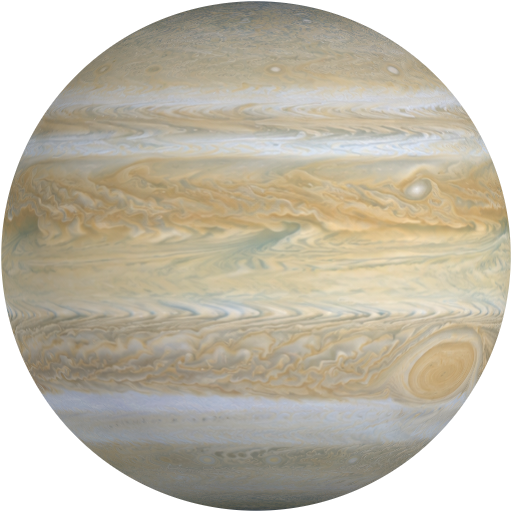
Sixth planetGas giant
The jewel of the Solar System, encircled by a dazzling system of ice and rock. Saturn is so light it would float in a large enough bathtub of water.
Key facts
Mass
95
× Earth
Radius
58,232 km
9.4× Earth
Gravity
10.44 m/s²
1.06× Earth
Temp
-140°C
cloud tops
Orbit & rotation
1.43 B km
from the Sun
9.6 AU
29.5 yrs
orbital period
orbital year
10.7 hours
length of day
rotation
Sunlight reaches here in 1h 20m
travelling at 299,792 km/s
Compared to Earth
Radius
9.14× Earth
Shown at reduced scale - true radius is 9.14× Earth.
Surface gravity10.44 m/s²
Blue line = Earth · scale 0–25 m/s²
A 70 kg person weighs74 kghere
Temperature
-140°Cmean surface
Pluto −230°Earth +15°Venus +465°
Atmosphere
Hydrogen96%
Helium3%
Other1%
Moons & rings
293 known moons
Titan ›Enceladus ›Rhea ›Mimas ›
Rings Spectacular - ~282,000 km wide but often under 1 km thick.
Notable
- It is the least dense planet - it would float in water.
- Titan has a thick atmosphere and lakes of liquid methane.
- Its rings are made mostly of billions of chunks of water ice.
1610
Discovery
Rings first seen by Galileo, resolved by Huygens (1655)
Missions & exploration
1979
Pioneer 11FlybyNASA
The first visitor - passed within 21,000 km of the cloud tops.
1980–81
Voyager 1 & 2FlybyNASA
Revealed the rings’ intricate structure and the braided F ring.
2004
CassiniOrbiterNASA/ESA/ASI
Thirteen years in orbit, ending in the Grand Finale dive of 2017.
2005
HuygensLanderESA
Landed on Titan - the most distant landing ever made.
2034
DragonflyPlannedNASA
A nuclear rotorcraft planned to fly across Titan’s dunes after a NET July 2028 launch and late-2034 arrival.
Inside Saturn
Molecular hydrogen47–100% of radius
The least dense planetary interior
Metallic hydrogen25–47% of radius
Source of the magnetic field
Rocky core0–25% of radius
10–20 Earth masses of rock and ice
Getting there from Earth
At light speed
1,200 million km
67 min
Fastest real trip
Cassini
6.7 years
By airliner
900 km/h, non-stop
152 years
By car
100 km/h, no breaks
1,369 years
Distances at closest approach; real routes are longer.