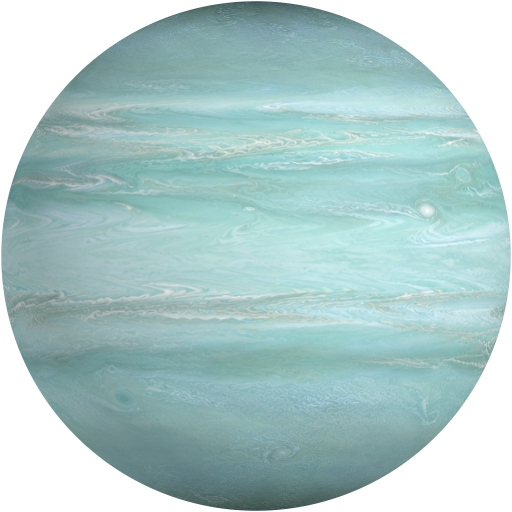
Seventh planetIce giant
A pale blue-green ice giant that rolls around the Sun on its side, likely knocked over by an ancient collision. Its methane atmosphere gives it that colour.
Key facts
Mass
14.5
× Earth
Radius
25,362 km
4.0× Earth
Gravity
8.87 m/s²
90% Earth
Temp
-195°C
coldest air
Orbit & rotation
2.87 B km
from the Sun
19.2 AU
84 yrs
orbital period
orbital year
17.2 hours
length of day
retrograde
Sunlight reaches here in 2h 40m
travelling at 299,792 km/s
Compared to Earth
Radius
3.98× Earth
Shown at reduced scale - true radius is 3.98× Earth.
Surface gravity8.87 m/s²
Blue line = Earth · scale 0–25 m/s²
A 70 kg person weighs63 kghere
Temperature
-195°Cmean surface
Pluto −230°Earth +15°Venus +465°
Atmosphere
Hydrogen83%
Helium15%
Methane2%
Moons & rings
29 known moons
Titania ›Oberon ›Miranda ›
Rings 13 faint, narrow rings.
Notable
- It spins on its side - a 98° axial tilt, unlike any other planet.
- Its atmosphere holds the coldest temperatures in the Solar System.
- It was the first planet discovered with a telescope.
1781
Discovery
Discovered by William Herschel
Missions & exploration
1986
Voyager 2FlybyNASA
The only spacecraft ever to visit - found 10 new moons and 2 rings in a six-hour encounter.
Inside Uranus
H/He atmosphere80–100% of radius
Methane up here gives the blue-green tint
Icy mantle20–80% of radius
A hot slush of water, ammonia and methane
Rocky core0–20% of radius
Only about half an Earth mass
Getting there from Earth
At light speed
2,570 million km
2h 23m
Fastest real trip
Voyager 2
8.5 years
By airliner
900 km/h, non-stop
326 years
By car
100 km/h, no breaks
2,932 years
Distances at closest approach; real routes are longer.