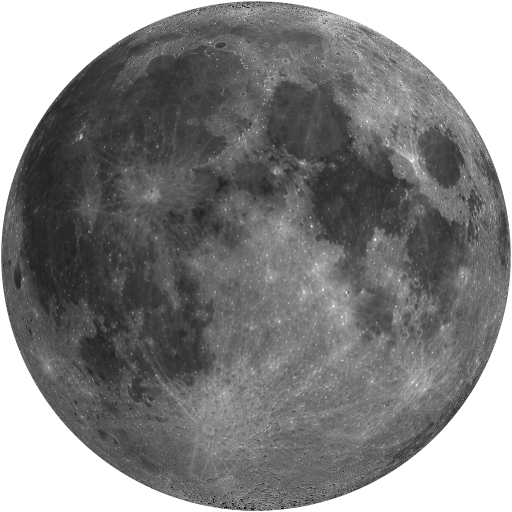
Earth’s satelliteRocky world
Earth’s constant companion and the only other world humans have walked on. Its gravity drives our ocean tides and steadies our planet’s tilt.
Key facts
Mass
0.0123
× Earth
Radius
1,737 km
0.27× Earth
Gravity
1.62 m/s²
17% Earth
Temp
-173→127°C
no air
Orbit & rotation
384,400 km
from Earth
from Earth
27.3 days
orbital period
around Earth
29.5 days
length of day
tidally locked
Sunlight reaches here in 8.3 min
travelling at 299,792 km/s
Compared to Earth
Radius
0.273× Earth
Smaller than Earth.
Surface gravity1.62 m/s²
Blue line = Earth · scale 0–25 m/s²
A 70 kg person weighs12 kghere
Temperature
-20°Cmean surface
Pluto −230°Earth +15°Venus +465°
Atmosphere
None to speak of - only a near-vacuum exosphere. Footprints left by astronauts could last millions of years.
Moons & rings
0 moons of its own
Rings None.
Notable
- 12 people have walked on its surface (1969–1972).
- It is slowly drifting away from Earth - about 3.8 cm per year.
- Always shows us the same face - it is tidally locked.
-
Discovery
Known since prehistory
Missions & exploration
1959
Luna 2ImpactorUSSR
First spacecraft to reach another world.
1959
Luna 3FlybyUSSR
Returned the first images of the Moon’s far side.
1966
Luna 9LanderUSSR
First soft landing - proved the surface could bear a spacecraft’s weight.
1966
Luna 10OrbiterUSSR
First spacecraft to orbit another celestial body.
1966
Surveyor 1LanderNASA
First American soft landing on the Moon.
1969
Apollo 11CrewedNASA
First humans on another world - “one giant leap”.
1970
Luna 16Sample returnUSSR
First robotic mission to return lunar soil to Earth.
1970
Lunokhod 1RoverUSSR
First successful rover to drive on another world.
1972
Apollo 17CrewedNASA
The last crewed visit; the longest stay, at 75 hours.
2019
Chang’e 4RoverCNSA
First landing on the far side.
2020
Chang’e 5Sample returnCNSA
Returned the first fresh lunar samples since Luna 24 in 1976.
2023
Chandrayaan-3LanderISRO
First landing near the lunar south pole.
2024
Odysseus / IM-1LanderIntuitive Machines/NASA CLPS
First commercial lunar landing and first U.S. Moon landing since Apollo 17.
Inside The Moon
Crust97–100% of radius
~40–60 km of ancient cratered highlands
Mantle20–97% of radius
Solid and seismically quiet
Core0–20% of radius
Small and partially molten
Getting there from Earth
At light speed
384,400 km
1.3 sec
Fastest real trip
Apollo 11
3 days
By airliner
900 km/h, non-stop
18 days
By car
100 km/h, no breaks
5 months
Distances at closest approach; real routes are longer.